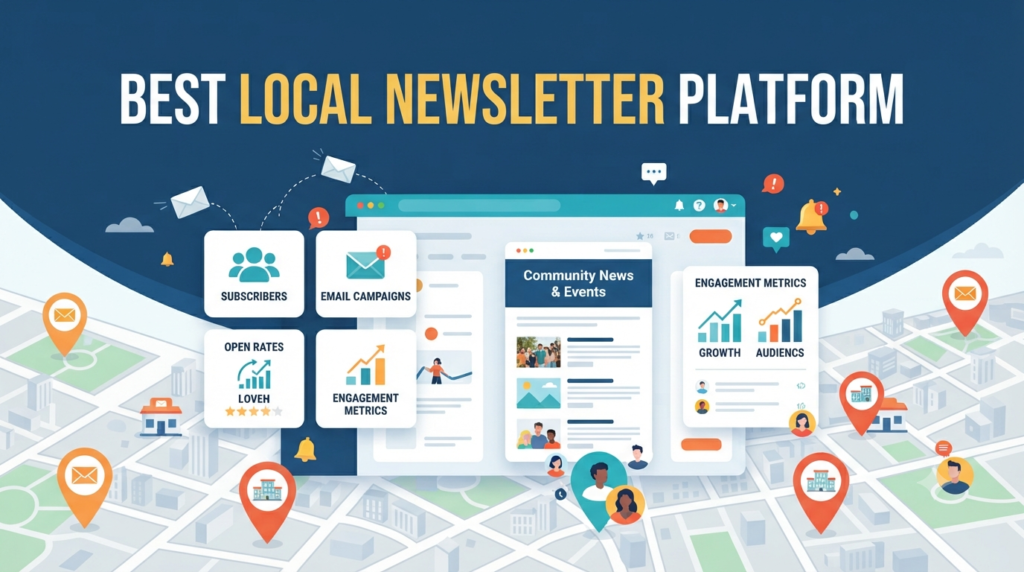

Picking the best local newsletter platform is a strange decision. Most newsletter tools were built for creators with a national audience: a writer with opinions, a coach with a course, a brand with a mailing list. A local newsletter is a different animal.You’re not writing about yourself. You’re writing about a place. Your content is events, openings, closures, school news, the new taco truck and the road that’s closed for three weeks. Your revenue usually comes from the dentist, the realtor and the café down the street, not from readers paying $8 a month.So the best local newsletter platform isn’t necessarily the most popular one, and that’s the first thing to understand. It’s the one that makes a weekly local issue easy to produce and easy to sell around.I’ve compared seven options below, ranked for local publishers specifically. You’ll see what each does well, what it doesn’t, how it makes you money, and who it suits.
How Local Newsletters Actually Make Money
Before choosing the best local newsletter platform, it helps to understand how local newsletters earn, because the money model decides which tools you need.
Look at the local newsletters that have built real businesses. 6AM City grew into a multi-city network of free daily newsletters funded largely by advertising. Naptown Scoop in Annapolis, Maryland, profiled by Side Hustle Nation, turned a free local email into a business through sponsorships. Different scales, same pattern: free to readers, paid for by local businesses.
That’s the norm, not the exception. Here’s why:
- Local audiences are capped. A town of 50,000 people has a limited number of potential subscribers. Charging them shrinks that number further.
- Local businesses value local attention. A café can’t easily buy ads that reach only people within three miles. You can sell exactly that.
- Directories and listings recur. A business that pays for a featured listing tends to renew if it works.
So for most local publishers, the best local newsletter platform is one that helps you sell to businesses: sponsor slots, ad scheduling, invoices, a directory. Paid subscriptions are a nice extra, not the engine.
If you’re the exception, a writer whose readers will genuinely pay, Substack and Ghost move up the list.
How I Judged Each Platform
Every tool was scored on the things that actually matter for a town, city or neighbourhood newsletter:
- Weekly workflow speed. How long does one local issue take to produce?
- Local content support. Does it help you find and write local stories, or are you on your own?
- Monetization tools. Sponsorships, ad management, directories, paid subscriptions.
- Growth tools. Signup pages, referrals, recommendations.
- Website and archive. Does every issue live on a searchable web page with your own custom domain?
- Cost as you grow. What happens to your bill at 1,000, 5,000 and 10,000 subscribers?
- Ease of use. Could a non-technical side hustler run it?
The Best Local Newsletter Platform Rankings at a Glance
Here’s how each tool ranks when the job is choosing the best local newsletter platform for a town or city publication.
| Rank | Platform | Best for | Pricing model | Local-specific tools |
|---|---|---|---|---|
| 1 | Local Media Empire | All-in-one local publishing and ad sales | One-time launch price + optional upgrades | Yes |
| 2 | beehiiv | Growth-focused newsletters | Free plan + monthly tiers by list size | No |
| 3 | Ghost | Independent local journalism with memberships | Monthly hosting or self-host | No |
| 4 | Substack | Writers who want readers to pay | Free + 10% of paid subscription revenue | No |
| 5 | Kit | Email automation and landing pages | Free plan + monthly tiers | No |
| 6 | Mailchimp | Businesses already using it | Limited free plan + monthly by contacts | No |
| 7 | WordPress + plugins | Full custom builds | Free software + hosting and plugins | Via plugins |
Prices and plan names change often. Check each official pricing page before you commit.
1. Local Media Empire: Best All-in-One Local Newsletter Software
Best for: side hustlers, marketers and small agencies who want to earn from local businesses.
Local Media Empire is the only tool on this list built specifically as local newsletter software. You set a coverage area, and the platform finds local news, events and new business openings. AI drafts local articles from those finds. You edit, build the issue, and publish to email and your publication’s website at the same time.
What stands out:
- Local content discovery, which solves the “what do I write this week?” problem
- AI local articles: events, community news, weather, business spotlights
- Newsletter builder, website with custom domain, signup pages and subscriber management in one place
- Upgrades for a local business directory, ad management (placements, schedules, billing, invoices), more publications and client accounts
- One-time pricing at launch ($37 front end), with no cut of your revenue
Where it falls short:
- It’s new (launched September 2026), so there’s little track record
- Growth tools are basic compared with beehiiv’s referral program
- Paid reader subscriptions aren’t the core focus
- Client publications aren’t full white-label
- AI drafts need human fact-checking
Why it ranks first: for a local publisher who plans to sell ads, sponsorships and directory listings, it’s the only option that covers content, publishing and local monetization tools in one place. That’s what makes it my pick for the best local newsletter platform overall in 2026, with the caveat that it’s young.
Ideal user: a marketer in a city of 80,000 who already knows a dozen local business owners, wants a weekly events-and-openings newsletter, and plans to sell sponsor spots and featured directory listings within three months.
Read more: Local Media Empire review.
2. beehiiv: Best for Growth
Best for: publishers who want to grow fast and like a polished, mature platform.
beehiiv is one of the strongest newsletter platforms anywhere. Its referral program, recommendations network and analytics are excellent, and it offers an ad network, paid subscriptions and a website builder. It has a free plan for smaller lists.
What stands out:
- Best-in-class referral and recommendation tools for subscriber growth
- An ad network that can bring sponsors to you
- Paid subscriptions supported
- Custom domains and websites on its plans
- Large community and a long track record
Where it falls short for local:
- No local content discovery or local AI drafting
- No business directory
- The ad network suits bigger or niche audiences more than a town of 2,000 readers
- Paid plans are priced by subscriber count; beehiiv renamed its plans (Launch → Free, Scale → Lite, Max → Pro) and raised prices on many tiers in October 2026
Verdict: if growth tools matter most, beehiiv is a superb choice, and for some publishers it’s the best local newsletter platform even without local features. You’ll handle local content and local ad sales yourself.
Ideal user: a publisher who enjoys writing, has a growth plan built around referrals, and is comfortable paying monthly once the list takes off.
Full comparison: Local Media Empire vs beehiiv.
3. Ghost: Best for Independent Local Journalism
Best for: journalists and editors building a serious, long-term local news outlet.
Ghost is open-source publishing software with built-in memberships and newsletters. You can self-host it or pay for Ghost(Pro). Many independent local news startups use Ghost because it looks professional and gives them real ownership.
What stands out:
- Beautiful, fast websites with strong SEO
- Built-in memberships and paid subscriptions, with no revenue cut on its paid hosting plans
- Full ownership if you self-host
- A professional feel that suits real journalism
Where it falls short for local:
- No AI drafting or local content discovery
- No directory or local ad management
- Ghost(Pro) pricing scales with audience size; the entry plan has a small member cap
- Self-hosting requires technical skill
Ideal user: a former reporter launching an independent outlet covering city hall, schools and local business, funded by memberships and a few sponsors.
Verdict: the best newsletter platform for community journalism done seriously, especially with a membership model. If your local outlet is journalism-first, Ghost could be your best local newsletter platform.
4. Substack: Best for Paid Writing
Best for: writers with a strong voice who want readers to pay them.
Substack is free to use and takes 10% of paid subscription revenue. Its editor is simple, and its app and recommendations help readers discover you.
What stands out:
- Free to start, extremely simple
- Paid subscriptions built in
- Network discovery through the app and recommendations
- Custom domain supported
Where it falls short for local:
- No tools for local advertisers, directories or ad scheduling
- Its global discovery network doesn’t help much with a town audience
- Paid local subscriptions are hard to sell in smaller markets
Verdict: great for local commentary and paid writing. Weak for ad-supported local newsletters.
Ideal user: a well-known local columnist whose readers already follow their opinions and would pay a few dollars a month for more.
Full comparison: Local Media Empire vs Substack.
5. Kit: Best for Email Automation
Best for: publishers who want automated sequences, landing pages and digital product sales.
Kit (formerly ConvertKit) is a creator-focused email marketing platform. It’s excellent at automations, tagging and landing pages, and offers a free plan for smaller lists.
What stands out:
- Strong automations and segmentation
- Landing pages and forms
- Creator recommendations network
- Digital product sales
Where it falls short for local:
- Website and archive features are lighter than dedicated publishing tools
- No local content tools, directory or local ad management
Ideal user: a local food blogger who sells a city dining guide and wants automated welcome sequences that promote it.
Verdict: a solid email engine. Better for funnels than for a weekly local news product.
6. Mailchimp: Best if You Already Use It
Best for: small businesses and organisations that already run Mailchimp.
Mailchimp is the email tool many local businesses already know. It’s reliable and familiar, with templates, automations and a limited free plan.
What stands out:
- Familiar, widely used, lots of templates
- Good for organisations already on it, such as chambers of commerce or community groups
Where it falls short for local:
- Pricing climbs with contacts, which hurts as your list grows
- Not built for publishing a newsletter as a media product
- No local content, directory or sponsor management tools
Ideal user: a residents’ association secretary who already has 400 contacts in Mailchimp and just needs a tidy monthly update.
Verdict: fine for a business or community group newsletter. Not my choice for a local media business.
7. WordPress + Plugins: Best for Full Control
Best for: technical builders who want a custom local news site.
WordPress can do everything with enough plugins: a news theme, a newsletter plugin, an email sending service, a directory plugin and an ad manager.
What stands out:
- Total control and ownership
- Excellent SEO potential
- Endless customisation
Where it falls short:
- Hosting, plugins, updates, security and backups are all your job
- Setup takes days, not hours
- Newsletter sending needs extra tools
Verdict: the most flexible option, and the most work.
Ideal user: a developer or agency building a multi-section local news site with events, jobs and classifieds, who enjoys tinkering with plugins.
Full comparison: Local Media Empire vs WordPress.
Monetization Tools Compared
Choosing the best local newsletter platform usually comes down to money. Most local newsletters live or die by monetization tools, so here’s how the platforms stack up.
| Platform | Sponsorships | Ad management | Directory | Paid subscriptions | Ad network | Client publications |
|---|---|---|---|---|---|---|
| Local Media Empire | Yes | Yes (upgrade) | Yes (upgrade) | Not core | No | Yes (upgrade) |
| beehiiv | Manual | Basic | No | Yes | Yes | No |
| Ghost | Manual | No | No | Yes | No | No |
| Substack | Manual | No | No | Yes | No | No |
| Kit | Manual | No | No | Yes | No | No |
| Mailchimp | Manual | No | No | No | No | No |
| WordPress | Via plugins | Via plugins | Via plugins | Via plugins | No | DIY |
Notice the pattern. Most platforms assume readers or national advertisers will pay. Local newsletters usually earn from local businesses, which is why ad management and a directory matter so much more for this use case.
Cost as You Grow
| Platform | At launch | At 5,000 subscribers |
|---|---|---|
| Local Media Empire | $37 one-time (launch price) | Same; upgrades optional, one-time |
| beehiiv | Free plan | Paid plan priced at your list size |
| Ghost(Pro) | Monthly entry plan | Higher monthly plan |
| Substack | Free | Free (10% of paid subscriptions only) |
| Kit | Free plan | Paid plan by list size |
| Mailchimp | Limited free plan | Paid plan by contacts |
| WordPress | Hosting + plugins | Bigger hosting + email sending costs |
I’ve kept this qualitative on purpose: several of these tools changed pricing in 2026, and exact figures depend on billing cycle and list size.
Best Platform for Local Newsletter Publishers, by Situation
The best platform for local newsletter success depends on your plan. Here’s my quick guide.
- “I want to earn from local businesses and save time.” Local Media Empire.
- “I want the biggest audience as fast as possible.” beehiiv.
- “I’m a journalist building a real local outlet.” Ghost.
- “I want readers to pay me.” Substack or Ghost.
- “I want automations and product sales.” Kit.
- “I run a chamber or community group already on Mailchimp.” Mailchimp.
- “I’m technical and want total control.” WordPress.
The Best Newsletter Platform for Community Groups
What about non-profits, residents’ associations and chambers of commerce? The best newsletter platform for community groups is usually the simplest one people will actually use. Mailchimp and Substack are easy for volunteers. If the group wants to sell local sponsorships or run a business directory, Local Media Empire fits better.
Features That Matter Most for a Newsletter Platform for Local News
If you’re comparing any newsletter platform for local news, prioritise these:
- Time per issue. Weekly consistency beats everything else.
- Local content help. Discovery and drafting save the most hours.
- Email + web publishing. Your archive becomes search traffic.
- Custom domain. You look like a real local outlet.
- Ad management and a directory. These are how local publications earn.
- Predictable costs. Watch tools that get much pricier as you grow.
Your First 30 Days on Any Platform
Whichever tool you choose, the first month looks similar. Here’s the plan I’d follow:
- Week 1: set up your publication, custom domain and signup page. Write a short “what this is” welcome email.
- Week 2: send issue #1 to friends, family and 20 to 50 locals you know. Ask each to forward it once.
- Week 3: share your signup page in two or three local Facebook groups (follow their rules), and leave a QR code flyer at a friendly café.
- Week 4: offer a free sponsor spot to one local business you like. Use it as proof when you start selling.
By day 30 you’ll know more about which platform suits you than any comparison article can tell you. That’s why the best local newsletter platform for you is partly the one you’ll actually keep using.
Questions to Ask Before You Sign Up
Run every option through these five questions before you hand over a card number:
- Can I publish one full local issue in under three hours on this tool?
- Will my bill jump when I hit 2,500, 5,000 or 10,000 subscribers?
- Can I sell and track a sponsor without a second piece of software?
- Can I export my list and archive in a format another tool accepts?
- Will a local business owner take my publication seriously when they see it?
If a platform fails two or more of those, keep looking. Honestly, that short list does more than any feature chart.
Mistakes to Avoid When Choosing
- Choosing by brand name alone. The most famous tool may not suit a local ad model.
- Ignoring the revenue model. Paid subscriptions and local ads need different tools.
- Underestimating weekly time. Most local newsletters fail from burnout, not bad software.
- Switching too often. Commit to one platform for at least six months.
- Forgetting the domain. Always publish on your own custom domain.
My Verdict: The Best Local Newsletter Platform in 2026
For most people starting a local newsletter to earn money from local businesses, my pick for the best local newsletter platform is Local Media Empire. It’s the only tool here that combines local content discovery, AI local articles, email and web publishing, a directory and local ad management, at a one-time launch price.
If you care most about growth, choose beehiiv. If you’re building serious local journalism with memberships, choose Ghost. If you want readers to pay you, choose Substack.
Whatever you pick as your best local newsletter platform, the platform won’t be what makes your newsletter work. Showing up every week with genuinely useful local information will.
Next step: read how to start a local newsletter business.