
“Can a local newsletter actually make money?”
It’s the first question everyone asks, and most answers are either wildly optimistic (“$10k a month on autopilot!”) or uselessly vague (“it depends”). So let’s answer how much do local newsletters make with real numbers where they exist, simple maths where they don’t, and an honest look at what’s typical versus exceptional.
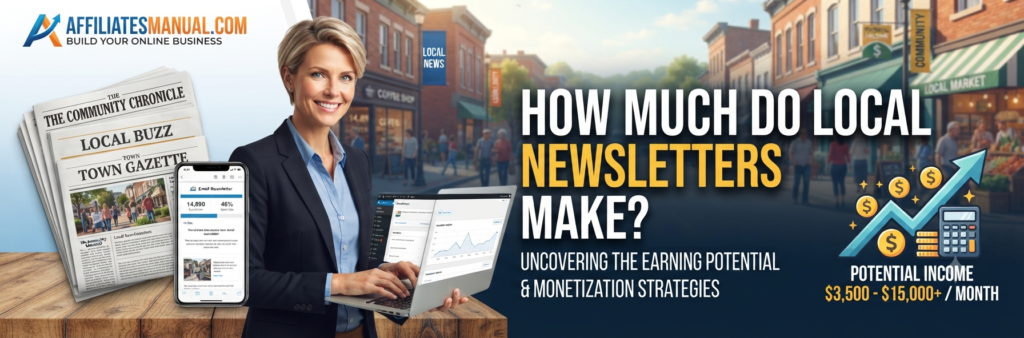
Short version: a small local newsletter might earn a few hundred dollars a month in its first year. A well-run one in a decent-sized town can earn six figures. The gap between those two is mostly time, consistency and sales.
The Best-Known Example: Naptown Scoop
If you want proof that a local newsletter can be a real business, start with Naptown Scoop.
Ryan Sneddon launched it in August 2020 for Annapolis, Maryland, a city of roughly 40,000 people. It covers fun things happening in town: events, food, openings, local happenings. Light, useful, friendly.
Here’s what’s been publicly reported:
| Metric | Reported figure | Source |
|---|---|---|
| Location | Annapolis, Maryland (~40,000 residents) | Side Hustle Nation, The Tilt |
| Launched | August 2020 | Side Hustle Nation |
| Subscribers | About 18,000, almost half the city’s population | Side Hustle Nation |
| Open rate | 65% (end of 2023) | The Tilt |
| Annual revenue | Over $200,000 | Side Hustle Nation, The Tilt |
| Main revenue source | Advertising | The Tilt |
| Early growth tactic | Facebook ads, run steadily for about two years | SparkLoop |
That’s around $11 of revenue per subscriber per year, from a town smaller than many suburbs. Later interviews talked about targets well above that, with a small staff.
Is Naptown Scoop typical? No. And that’s worth saying clearly, because it’s easy to read a $200,000 headline and assume it’s normal. It isn’t. It’s one of the best-run local newsletters around, and Ryan worked on it full time. But it shows the ceiling is much higher than most people assume.
How Much Do Local Newsletters Make at Each Stage?
Most local newsletters aren’t Naptown Scoop, at least not yet. So how much do local newsletters make when they’re ordinary, decent, and still growing? Here’s a more realistic picture of local newsletter income by stage. These are illustrative ranges based on common sponsorship pricing, not guarantees.
| Stage | Subscribers | Typical revenue sources | Rough monthly revenue |
|---|---|---|---|
| Launch (months 1–3) | 0–800 | Free or discounted sponsor spots | $0–$300 |
| Early (months 4–9) | 800–2,500 | 1–4 sponsors, a few listings | $300–$1,500 |
| Established (year 1–2) | 2,500–8,000 | Regular sponsors, directory, classifieds | $1,500–$6,000 |
| Mature (year 2+) | 8,000–20,000+ | Full sponsor calendar, events, jobs, multiple streams | $6,000–$25,000+ |
The jump between stages isn’t automatic. It comes from selling. A newsletter with 5,000 subscribers and no sales effort can earn less than one with 1,500 subscribers and an owner who calls three businesses every Friday.
Where Local Newsletter Revenue Comes From
Local newsletter revenue usually comes from a mix of these streams.
1. Sponsorships and ad spots
The main engine for most local newsletters. A business pays to appear in an issue: a top sponsor slot, a featured mention, or a smaller classified-style ad. Naptown Scoop, for example, earns most of its revenue from advertising.
2. Directory listings
Free basic listings, paid featured or premium listings. This creates recurring revenue because businesses renew monthly.
3. Events
Hosting or co-hosting local events: tastings, markets, trivia nights, community fundraisers. Tickets plus event sponsors.
4. Job boards and classifieds
Local employers pay to post jobs. Residents pay small fees for classifieds.
5. Memberships or paid tiers
Some local newsletters add a paid tier with extras. It’s usually a smaller share of revenue than advertising.
6. Affiliate deals
Commissions on local event tickets, hotel bookings or deals.
The Maths: Subscribers, CPM and Ad Spots
How much do local newsletters make per ad? Most price using CPM (cost per thousand subscribers) or a flat rate per issue.
Local CPMs tend to be higher than national ones because local businesses value nearby readers so much. Here’s a simple example with illustrative numbers:
| Input | Example |
|---|---|
| Subscribers | 3,000 |
| CPM for a top sponsor slot | $40 |
| Price per top slot | 3 × $40 = $120 |
| Ad spots per issue | 2 (top + featured at $80) |
| Revenue per issue | $200 |
| Issues per month | 4 |
| Monthly sponsorship revenue | $800 |
Add 20 featured directory listings at $30 a month ($600) and a couple of job posts ($100), and that newsletter makes about $1,500 a month.
Now double the subscribers, raise the CPM as your open rate proves itself, and add a second weekly issue. That’s how local newsletter earnings climb. For pricing details, read local newsletter advertising rates.
Revenue per Subscriber: The Number That Matters
The cleanest way to compare newsletters is revenue per subscriber per year.
- Naptown Scoop: roughly $11 per subscriber per year (about $200,000 from about 18,000 subscribers).
- A small, newly monetised local newsletter: often $1 to $5 per subscriber per year.
- A well-sold local newsletter with several revenue streams: $8 to $20+ per subscriber per year.
Why does revenue per subscriber vary so much? Three reasons:
- Engagement. High open rates (Naptown Scoop reported 65%) make each subscriber worth more to advertisers.
- Sales effort. More sponsor conversations equal more filled slots.
- Number of revenue streams. Ads plus listings plus events beats ads alone.
Is a Local Newsletter Profitable?
Is a local newsletter profitable? Usually, yes, once it’s monetised, because costs are low.
| Cost | Typical monthly range |
|---|---|
| Newsletter platform | $0–$100+ (or one-time tools) |
| Domain | ~$1–$2 |
| Growth ads | $0–$500 |
| Design tools | $0–$15 |
| Contractors (optional) | $0–$1,000+ |
A solo publisher can run on less than $100 a month in many cases. That means even $1,000 a month in revenue is mostly profit. The real cost is time, often four to eight hours a week.
Small Town vs Mid-Sized City vs Big City
Market size changes the answer to how much do local newsletters make. Here’s a rough way to think about it.
| Market | Subscriber ceiling | Advertiser pool | Typical strategy |
|---|---|---|---|
| Small town (10,000–30,000) | Low thousands | Limited, very loyal | Reach a big share of town; sell directory + sponsors |
| Mid-sized city (30,000–200,000) | Up to tens of thousands | Healthy and varied | The sweet spot for a solo publisher |
| Big city neighbourhood | Thousands per neighbourhood | Large but competitive | Go hyperlocal; one district at a time |
| Whole big city | Very high | Huge, but national players compete | Usually needs a team and funding |
Annapolis, at around 40,000 people, shows how far a mid-sized market can go when a large share of residents subscribe. A small town can still work, but you’ll rely more on a few loyal advertisers and listings.
How to Raise Your Revenue per Subscriber
Once you have readers, the fastest way to earn more is often not more subscribers. It’s more revenue from the ones you have.
- Add a second ad slot per issue, priced below your top slot.
- Sell three-month packages instead of single issues.
- Launch a directory with paid featured listings.
- Add a weekly jobs section for local employers.
- Host one event a quarter with a sponsor.
- Raise rates every six months as your list and open rate grow.
Each one is a small step. Together, they can double what each subscriber is worth to you.
What Makes Some Local Newsletters Earn More
From the successful examples, a few patterns stand out:
- Strong local personality. Readers feel they know the writer.
- Useful, light content. Events and openings beat heavy politics for broad appeal.
- A big share of the town subscribed. Naptown Scoop reached almost half its city.
- Early investment in growth. Paid social ads helped Naptown Scoop scale quickly.
- Concentrated advertisers. A handful of loyal, recurring sponsors often bring in a big chunk of revenue. Keep them happy.
- Consistent schedule. Readers build a habit around your send time.
How Much Do Local Newsletters Make for Agencies?
There’s a second way to earn from local newsletters: building them for local businesses. Instead of selling ad spots, you charge setup fees and monthly management.
For example, Local Media Empire’s Client Version suggests packages like a $297 publication setup or a $497 publication plus directory setup, with monthly management priced by you. Its own illustration of 10 clients at $497 a month comes to $4,970 a month. That’s an example, not a forecast, but it shows a different path to revenue that doesn’t depend on growing your own audience first. See how to start a local media agency.
Case Study Lessons You Can Use
If you take one case study lesson from Naptown Scoop, make it this: the business was built on being genuinely useful to one town, every single week, and on treating advertisers as partners. The tools mattered less than the habit.
Practical takeaways:
- Pick a town you know and love.
- Publish on a fixed schedule.
- Spend on growth early if you can.
- Sell to local businesses from the first few hundred subscribers.
- Track revenue per subscriber and try to raise it every quarter.
Final Answer: How Much Do Local Newsletters Make?
So, how much do local newsletters make? Anywhere from a few hundred dollars a month for a new one, to $200,000 or more a year for an outstanding one like Naptown Scoop.
Most people who stick with it for a year, in a decent market, with steady sales effort, can reach $1,000 to $5,000 a month. Some go far beyond that. Some quit before they get there.
The difference isn’t luck. It’s consistency, usefulness and the willingness to sell.
Ready to start? Read how to start a local newsletter business, or see the tools I recommend in my Local Media Empire review.
Figures for Naptown Scoop are as publicly reported by Side Hustle Nation, The Tilt and SparkLoop. All other numbers are illustrations, not guarantees.
Sources: Side Hustle Nation · The Tilt · SparkLoop